
"Darmok and Jalad at Tanagra" and the Bible
Theopoetics is not exclusive to the written word

The study of theopoetics is an exploration of the use of metaphors within art to describe the holy. I’ve written elsewhere that poetry has really helped me to understand and interpret the Bible. But theopoetics is not exclusive to the written arts. I would say even television and movies can help us explore the holy and inform our interpretation of the Scriptures.
One such television show is Star Trek: The Next Generation. There is much written regarding the intersection of Star Trek of the 90s and the holy. But I want to focus on one episode, one that many fans believe to be the best in Star Trek: Darmok.

In this episode, Captain Picard, along with an alien who is a Tamarian, who is also a captain, are transported to the surface of a planet they are orbiting. The alien communicates only through metaphor and cultural references, which confuses Picard, who is usually straightforward and direct in his communication. Eventually, Picard realizes how the alien communicates: through stories and metaphors.
The alien expresses the situation they are in with a story from his cultural past: ‘Darmok and Jalad at Tanagra.’ After many misunderstandings, Picard came to understand what the alien was trying to communicate. The story of ‘Darmok and Jalad at Tanagra’ within the alien culture refers to two people coming together in cooperation to face adversity.
Captain Picard and the alien face off against a beast on the planet. They had to cooperate to survive the encounter. Though the alien loses his life, Picard communicates well with the alien ship, from what he had learned on the planet. And the aliens honored the encounter by recording it as, “Picard and Dathon at El-Adrel”.
Recently, I wondered if the writers of the New Testament were using stories metaphorically from their culture and Old Testament writings to describe how they understood Jesus in using the language of fulfillment.
You often see books or articles about the New Testament’s use of the Old Testament and how they saw various OT texts are fulfilled in Jesus Christ. I was listening to a podcast that explored the biblical authors’ use of the biblical text, not just between the New and the Old Testament, but throughout the whole Bible. But, regarding the NT authors’ use of the OT, one comment stood out for me regarding how Jesus fulfilled the OT texts:
“...fulfillment, it doesn’t mean that something was predicted. It can mean that, but it usually doesn’t mean that in the Bible. It’s usually that the Lord is actualizing into reality something that was not even necessarily anticipated.”1
When Matthew writes about Jesus’ parents taking him to Egypt to hide from Herod, he looks back at the stories from his culture and uses them to describe metaphorically what is happening. He writes, “This was to fulfill what the Lord had spoken by the prophet, “Out of Egypt I called my son.”2
Matthew is not necessarily saying the prophet predicted the Son of God would be in Egypt and be called out of Egypt. But he is saying Jesus’ story parallels Israel’s story, adding legitimacy and importance to Jesus. Throughout Matthew’s gospel Jesus is presented as the new Moses and the new Israel. Jesus fulfills these not as predictions but as parallels (or rhymes) to their story. Just as God worked in the past to bring Israel out of bondage and slavery. God is doing the same even now in Jesus Christ.
The entire story of Israel is a type and shadow for Jesus Christ. Israel’s story is used metaphorically to point to something greater.
Our civic culture uses stories as metaphors to communicate ideas as well. If I was to say, “Nero fiddled while Rome burned,” you would know I mean the leadership has misdirected priorities. Or “The emperor has no clothes,” you would know I mean there is a lie that is widely believed because of peer pressure. Stories from our western history (or folktales) used metaphorically to communicate an idea.
So, if Christians were Tamarians from Star Trek we might look to the incarnation and say, “Isaiah and the Virgin conceived.”
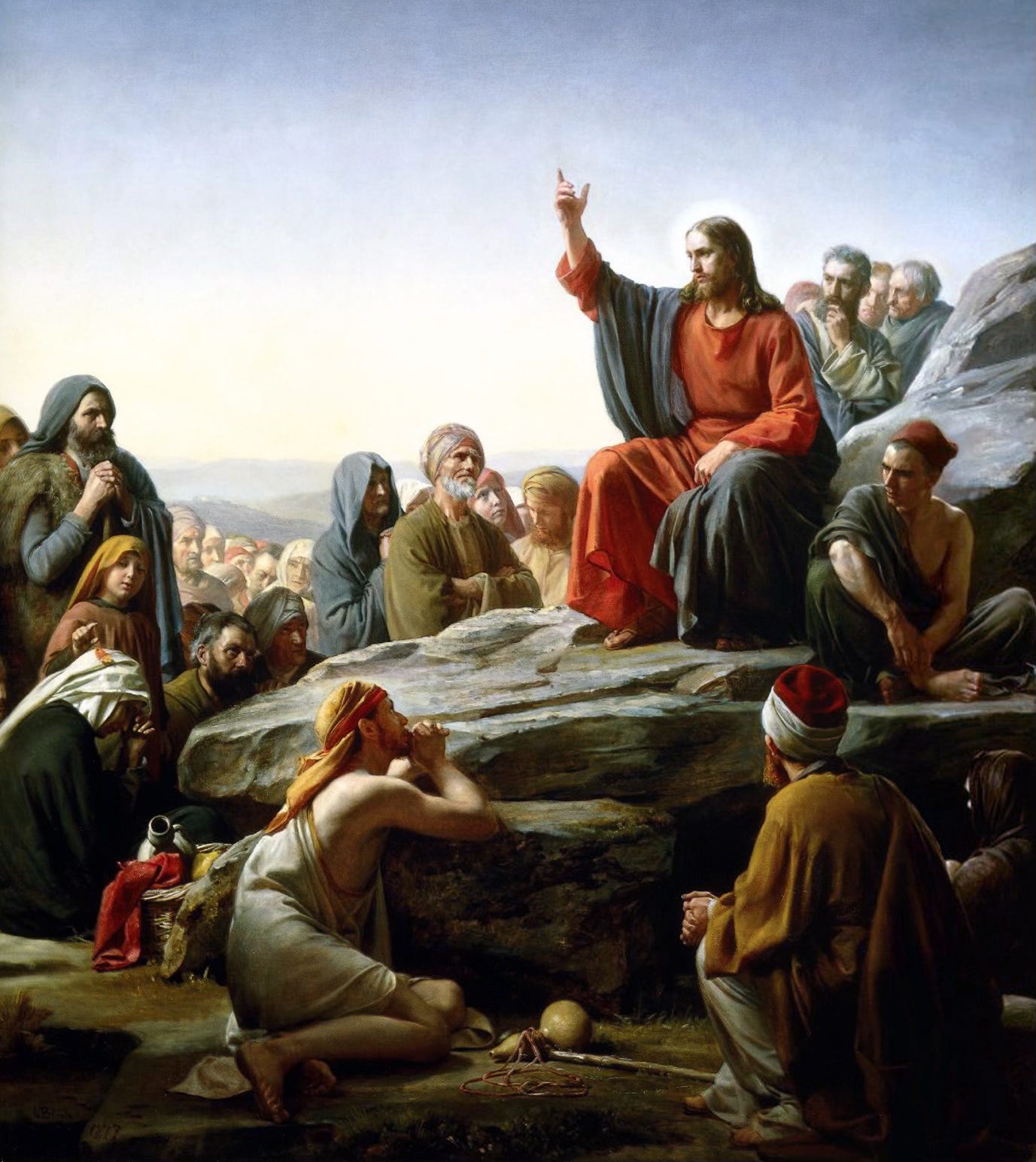
In describing Jesus’ Sermon on the Mount, we might say, “Moses with God on the Mountain.”
For the Crucifixion we might say, “Moses and the Passover Lamb,” or “Abraham and Isaac and the Ram.”
In describing Jesus’ burial, we might say, “Jonah and the Big Fish.”
We might look at the resurrection and say, “God and Adam and the Spirit (Breath)”.
Jesus’ ascension might be described, “Elijah and the Chariot of Fire,” or “Daniel and the Son of Man with the Ancient of Days.”
For Jesus’ return we could say, “The LORD trod the Winepress,” or “The Wolf Shall Dwell with the Lamb.”
I believe this might be how the New Testament writers used many of the stories in the Old Testament to point to Jesus. Not as predictions, but as metaphors to communicate what they mean when describing Jesus’ life, death, burial, resurrection, ascension, and soon return.
What do you think about how the New Testament writers used the Old Testament in their writings?
From OnScript: Gary Schnittjer – How To Study the Bible’s Use of the Bible (Live), Aug 11, 2025
Matthew 2:15